theiplegal_logo
  • AI, Software & Emerging Technology
  • Copyright Law
  • IP Licensing & Transactions
  • IP Strategy for Businesses
  • Patent Law
  • Trademark Law
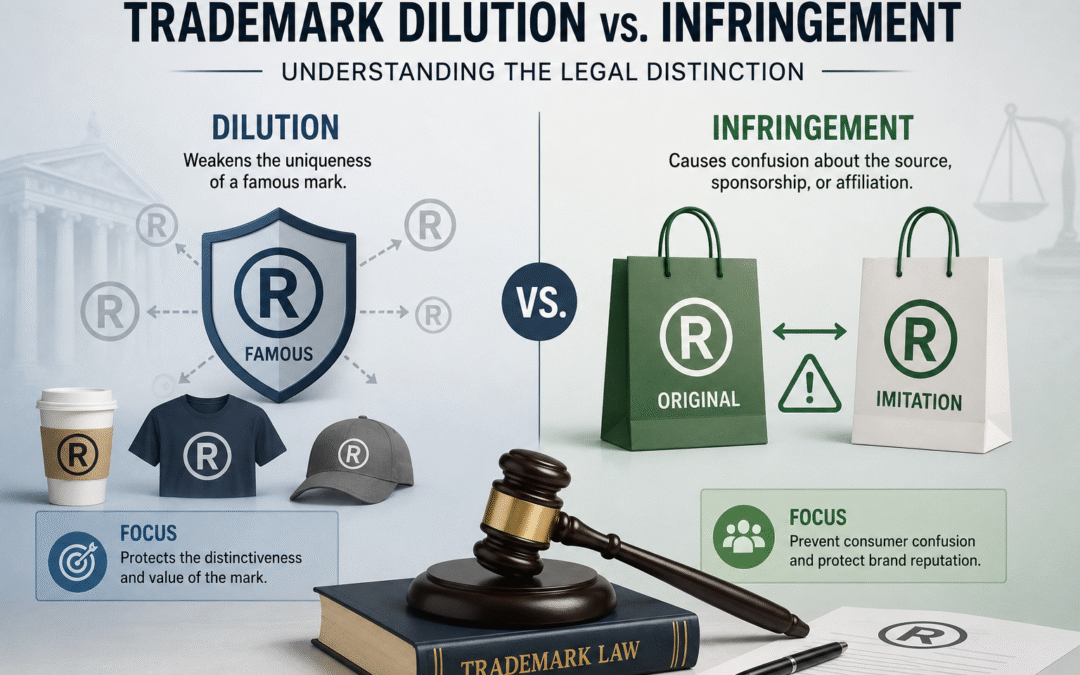
Trademark Dilution vs. Infringement: Understanding the Legal Distinction

Trademark Dilution vs. Infringement: Understanding the Legal Distinction

by Rahul Kapoor | Sep 4, 2026 | Trademark Law

When managing a brand, understanding the distinction between trademark dilution vs infringement is essential for effective intellectual property protection. While both concepts fall under the umbrella of trademark law, they serve different purposes and apply in unique...
Trademark Infringement in the Age of AI: Legal Risks for Brands

Trademark Infringement in the Age of AI: Legal Risks for Brands

by Rahul Kapoor | Sep 4, 2026 | Trademark Law

The Intersection of Generative AI and Brand Identity The rapid adoption of generative artificial intelligence has fundamentally altered how businesses create marketing materials, logos, and product designs. While these tools offer efficiency, they also introduce...
How the USPTO’s New Identity Verification Rules Impact Applicants

How the USPTO’s New Identity Verification Rules Impact Applicants

by Rahul Kapoor | Sep 3, 2026 | Trademark Law

Understanding the USPTO Identity Verification Requirements The United States Patent and Trademark Office (USPTO) has implemented rigorous identity verification requirements to maintain the integrity of the federal trademark register. As digital filing systems become...
International IP Protection: Expanding Your Business Abroad

International IP Protection: Expanding Your Business Abroad

by Rahul Kapoor | Sep 3, 2026 | IP Litigation & Enforcement

Expanding a business into new countries is an exciting milestone. However, as you move beyond domestic borders, you encounter a complex landscape regarding intellectual property rights. International intellectual property protection is not automatic; your domestic...
Common Pitfalls in Intellectual Property Licensing Agreements

Common Pitfalls in Intellectual Property Licensing Agreements

by Rahul Kapoor | Sep 3, 2026 | IP Litigation & Enforcement

Entering into an intellectual property licensing agreement is a strategic move for many businesses, allowing for the expansion of brand reach or the commercialization of proprietary technology. However, the complexity of these contracts means that even minor...
« Older Entries
Next Entries »

Recent Posts

  • Managing IP Risks in Joint Ventures for EV Development
  • Global Patent Strategy: Filing Under the Patent Cooperation Treaty (PCT)
  • The Defend Trade Secrets Act (DTSA): A Guide for Businesses-Legal Review Improved Draft
  • Public Disclosure and Patent Rights: The One-Year Grace Period
  • Provisional vs. Non-Provisional Patent Applications: Which to Choose?

Recent Comments

No comments to show.

© 2025 theIPLegal

  • Follow
  • Follow
Manage Consent
To provide the best experiences, we use technologies like cookies to store and/or access device information. Consenting to these technologies will allow us to process data such as browsing behavior or unique IDs on this site. Not consenting or withdrawing consent, may adversely affect certain features and functions.
Functional Always active
The technical storage or access is strictly necessary for the legitimate purpose of enabling the use of a specific service explicitly requested by the subscriber or user, or for the sole purpose of carrying out the transmission of a communication over an electronic communications network.
Preferences
The technical storage or access is necessary for the legitimate purpose of storing preferences that are not requested by the subscriber or user.
Statistics
The technical storage or access that is used exclusively for statistical purposes. The technical storage or access that is used exclusively for anonymous statistical purposes. Without a subpoena, voluntary compliance on the part of your Internet Service Provider, or additional records from a third party, information stored or retrieved for this purpose alone cannot usually be used to identify you.
Marketing
The technical storage or access is required to create user profiles to send advertising, or to track the user on a website or across several websites for similar marketing purposes.

  • Manage options
  • Manage services
  • Manage {vendor_count} vendors
  • Read more about these purposes
View preferences
  • {title}
  • {title}
  • {title}